
The AI-Enhanced Operator
When intelligence commoditizes, the operator becomes the asset.

Modern economics has long located value in specialization, and AI is no different.
Thus far an extraordinary general-purpose technology, AI’s primary products - foundational models and the agents they’ve spawned - require specialization to be useful, and value accrues to those specializing forces.
In Models Aren’t Moats I made the case for harnesses: the layer between the model and the user that assembles, packages, and productizes context, data, liability, and trust. Good harnesses compound their moat as the frontier models beneath them improve, instead of getting sherlocked.
But specialized intelligence has another form, less visible and more important: the people who actually wield this technology at the bleeding edge.
Much has been said about AI layoffs, evaporating coordination costs, and “individual contributors.” Less has been said about who these ICs actually are, and why we are paying them so much attention.
Even harnesses themselves are inextricably linked to these operators. A harness is conceived, built, and improved by people who understand the AI beneath them and the customer in front of them. Strip the operators out and the harness goes inert.
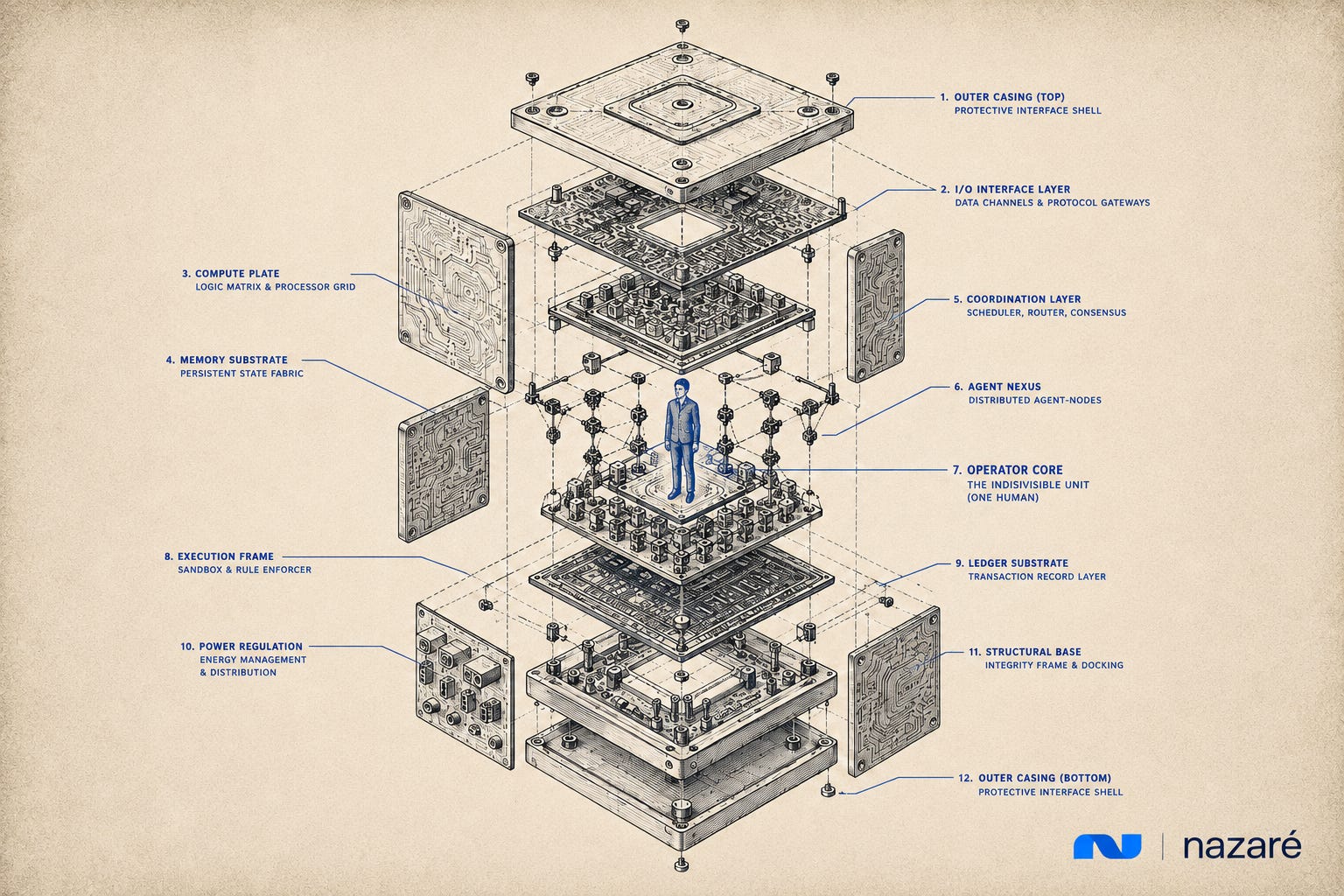
The AI-enhanced operator is no less than the atomic unit of value creation in AI: the smallest indivisible piece of specialized intelligence.
More importantly, the agent economy amplifies the properly-equipped individual operator. The agent economy will require highly AI-skilled individuals to achieve its full potential.
The Inversion: Division & Recombination
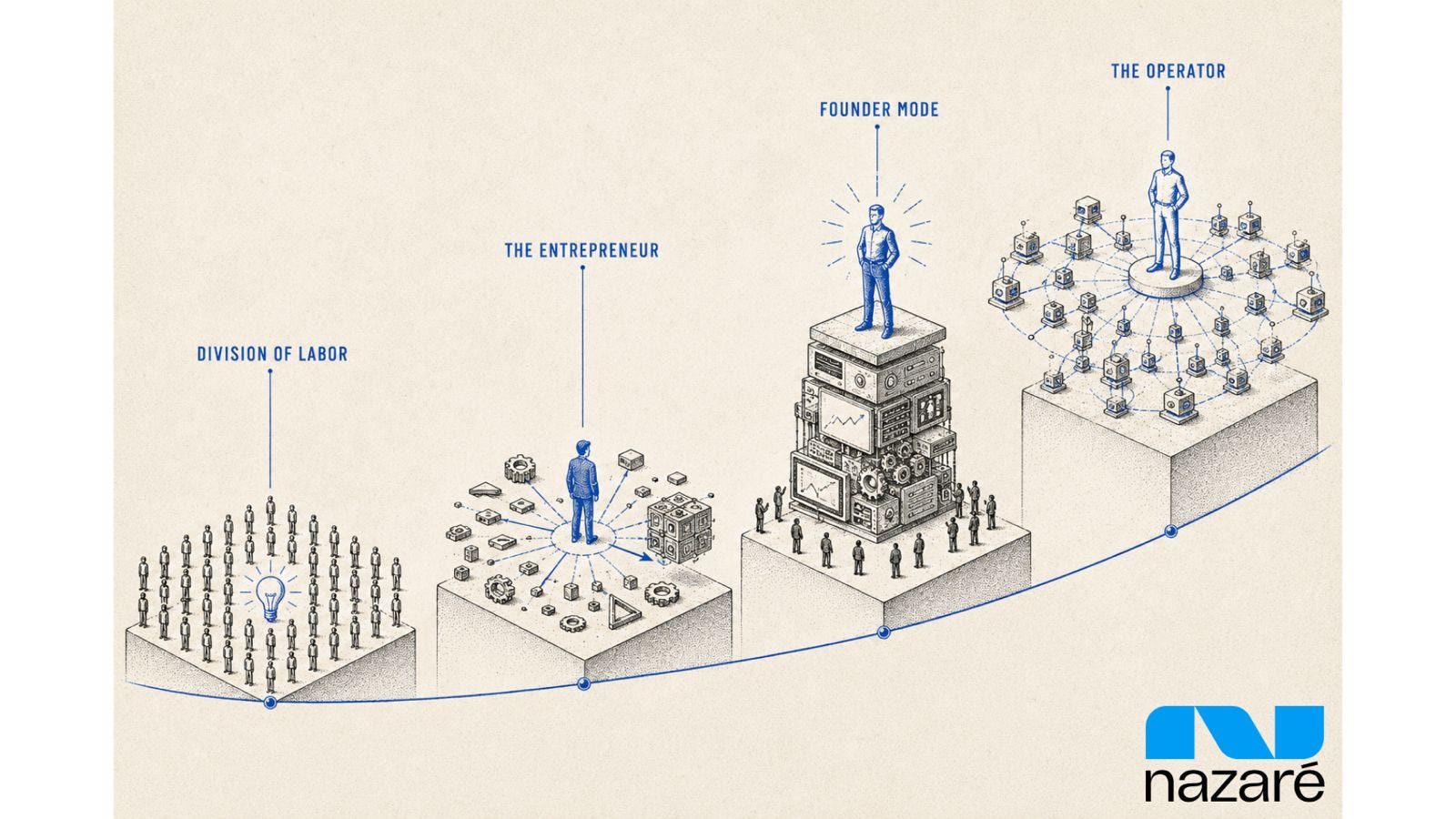
Specialization first took the form of “division of labour:” subdividing larger objectives into more manageable smaller tasks, with each individual performing only one. Industrial specialization created value by narrowing each person into a fragment, and value accrued to whoever organized the fragments. The individual was a necessary-but-insufficient input, a commodity waiting to be assembled around a good idea. The firm existed to be the whole no single person could.
Good ideas came from “Entrepreneurs,” individuals who recombined the disparate parts. Articulated by Frank Knight in the 1920s and expanded upon by Joseph Schumpeter in the 1930s, the figure turned on talent, skill, and judgment exercised under uncertainty, and on what Schumpeter called “new combinations”: new technologies, substrates, products, methods, markets, forms of organization, and the “creative destruction” they set off.
“Entrepreneurship” reached its apogee in the business schools and venture capital of the 1970s and 80s, canonized in Drucker’s Innovation and Entrepreneurship (1985). Each new information technology handed the entrepreneur more leverage, hardening the ideal into something close to a cult: founder mode, hustle culture, and the “996“ movement popularized by the AI race.
Industrial specialization narrowed the person to make the organization productive. Entrepreneurs were rewarded for the vision, recombination, and execution the organization couldn’t produce on its own.
AI specialization, on the other hand, elevates the individual in all of their singularity. One person with the right tools can now operate across domains and combine what used to require many specialists, putting Schumpeter’s new combinations within anyone’s reach.
John Coogan described this recently with filmmaking in Hollywood: “Being able to create something engaging for social media virality is probably somewhat important to creating a film that works in theaters, but the bigger value is being a ‘full stack’ filmmaker. Gone are the days of showing up to Hollywood with a manuscript and expecting a studio to do the rest for you. The traditionally segmented teams on productions are simply too expensive to be deployed on anything but existing IP. New projects will come from filmmakers who have experience and a view for every part of the filmmaking process.”
Never More Behind
That said, mastering AI is hard, and the target keeps moving. Three forces conspire against mastery: we’re extremely early to the technology, machines accelerate faster than humans, and everything compounds across substrate, model, agent, and regulation simultaneously.
Even leading AI engineers describe “never feeling more behind“ as the frontier moves. If even the experts feel behind, the condition cannot be considered failure. On the contrary, it’s the new status quo: a permanent state of working at the edge.
At Sohn 2026, Alex Sacerdote of Whale Rock noted that “only 10bps (0.1%) of the 1B worldwide white collar workers are using agentic AI in the way it will ultimately be used. Those 10bps are burning 1000x in compute / tokens as everyone else, and that 10bps is going to go 30-50%.”
Getting the most out of AI requires being a deeply entrenched power user, constantly experimenting with new ways of working. Specializing a generally-intelligent model isn’t obvious, which is why the frontier labs are themselves building business development consulting firms to teach customers how to use their products. It’s also why most of the world still uses AI as a chatbot or glorified search engine despite having an early form of AGI in their pocket.
First-Rate Intelligence
But the 0.1% aren’t smarter than their peers: nobody masters a moving target. In fact, what separates them is a disposition, not a skillset.
Elite operators deeply understand the technology, move within it, and adapt as the foundation shifts beneath them. They share a blend of rare qualities, most of which humans find uncomfortable.
Negative capability (Keats): holding two conflicting ideas, or an outright paradox, in mind at once without the urge to resolve it early. F. Scott Fitzgerald described it thusly: the test of a first-rate intelligence is the ability to hold two opposed ideas in the mind at the same time, and still retain the ability to function.
In practice, AI is perplexing. The “jagged frontier,” for example, makes no sense: superhuman intelligence should not be excellent at some tasks and inexplicably stupid for others. But such is the state of the art, and accepting as much is critical to success.
Continuous learning & building as the resting state: the static model of accumulating fixed knowledge gives way to figuring out what good work looks like by doing it, staying fluid as the ground shifts, and continuously recombining tools, models, and judgment to stay useful as the technology changes.
In practice it’s frustrating and unglamorous: talking to yourself with dictation software because ideas arrive faster than they can be typed, scrapping degraded context for a clean restart before errors compound, and rebuilding a personal stack every few months rather than waiting for the next release.
Strong beliefs loosely held: treating conclusions as provisional, letting go of hard-won progress without mourning it. The frontier rewrites itself quickly, often, and without warning, but decisions still have to be made. Decisive action, rapid iteration, and re-underwriting assumptions the moment new information is made available.
Comfort being outclassed: the machine will be better than you at the very craft you’ve spent your life mastering. How do you respond? Success means responding with constant curiosity and ego-death rather than defensiveness. What’s now possible that wasn’t before?
The profile showed up first where AI landed first: software engineering and writing code. But the same qualities can be found in artists. The very best artists not only master their specific craft (drawing, writing, singing, painting, sculpting, acting, making movies, etc.), they consistently reinvent themselves, trying on new styles, incorporating new tools, and pushing their limits.
AI feels heartless because many conceive of it as machines masquerading as humans. Its best practitioners may indeed be closer to artists in how they wield it.
The Buck Stops Here
I strongly believe agents are the new users, but I also believe they shouldn’t be fully autonomous. Agents need to be directed, their output needs to be controlled for quality and accuracy, and they must be held accountable -- none of which they can do on their own.
It follows that AI-enhanced individuals are not only immensely valuable, they’re required.
The agent economy will generate its own demand for them, because the better the machines get, the more the system depends on the few who can direct, manage, and answer for them.
Agents will also magnify them, making each one far more productive. The leverage an individual had was once limited by their own time and effort, and those limits have been removed. The more capable the agents become, the more a good operator’s singular skills and disposition are worth.
The Only Other Thing to Buy
Because everyone using AI now relies on roughly the same frontier models, “intelligence” itself has commoditized, and the intrinsic advantages of access are gone. The only remaining differentiation is how a given individual uses it, and the operator is thus diffusing into the economy faster than we can develop language for it.
At Sohn 2026, the most prominent investors in the world agreed on two things. AI is the defining investment of their lifetimes. And none of them could name a winner outside of infrastructure.
That reticence is rational, which I wrote about earlier this year: when the future past a certain point can’t confidently be visualized, capital crowds into consensus that survives the uncertainty. In AI, that consensus is scale, chips, memory, compute and the infrastructure that stands to do well no matter what finally emerges.
Some of these very investors recognized the importance of elite AI operators, though.
On the same Sohn panel, Sacerdote said: “...now we see what business AI is going to be. It’s Claude Code or something like that plugged into all your data sources, on top of which you build skills and then agents that actually go out and do things...For the first time we at whale rock, we’re looking to hire ‘Claude ninjas’ and we know we need help to build these amazing things.”
“Claude ninjas” is a fantastic name, but the joke doubles as a job description for people who can wield the models well enough to matter.
The market has conceived of a role around the same instinct: the forward-deployed engineer. Developed first inside Palantir, FDEs are now the best-in-class model used by AI-native companies as they go to market. The labs themselves adopted the framework, if not the name, when they launched their services initiatives.
The FDE is an AI-enhanced operator embedded with the client, equipped with enough leverage to have outsized impact on their own. The role has evolved into a peculiar alignment: the FDE’s job is to minimize spend while maximizing productivity, earning the client’s long-term commitment and lifetime value in return.
The same instinct informs how the most AI-native companies budget compute. Daniel Gross, the longtime investor and now co-lead of Meta Compute, described token allocation at Stripe Sessions 2026 the way a hedge fund allocates capital. Decision makers should treat themselves as portfolio managers, with their individual contributors as strategies, funded or defunded based on performance.
The market has observed that incentivizing tokenmaxxing in the aggregate is unproductive. The best way to spend compute is to bet on the best people. Unfortunately, elite operators are as scarce as the infrastructure itself. There simply aren’t enough of them.
Not Enough, and Fewer All the Time
Two things are scarce in AI. Compute is the bottleneck everyone can see and almost no one can touch: building data centers and buying chips is a game a handful of companies play with hundreds of billions of dollars, while everyone else consumes what they produce.
The second is the operator, and it matters to everyone, because getting more out of AI is something a single person or a whole company can work on directly, no matter their resources. Doing it well, however, is hard.
You might expect training to fix this, the way it usually fixes skill shortages. Eventually it will help, but right now the same conditions that make AI hard to master keep changing what you would teach faster than anyone can teach it. The same goes for regulation: AI just moves too fast.
Increased hiring can’t create more operators either. Like AI researchers before them, there are too few of them to go around, and because speed is critical and competitive advantages matter now, companies compete for the same small pool and pay more.
AI itself can’t yet take the operator’s place either, precisely because the operator is the person using AI, and agents still need direction.
All of which means effective operators aren’t interchangeable and are extremely valuable.
The companies that have them are rebuilding around them. Coinbase flattened its structure around the operators it kept. Armstrong’s framing – “rebuilding Coinbase as an intelligence, with humans around the edge aligning it” – is an accountability statement as much as an org chart one, naming where judgment and consequence terminate. Notion rebuilt its product and its company around agents and the people who direct them. Firms flatten toward operators because the two things that can’t be delegated – judgment and accountability – both require a certain kind of person: the operator.
This is what really decides which companies win, and it doesn’t show up in any of the usual numbers. I made a similar point about compute back in May: it’s no more fungible than engineers are, true on the org chart and false everywhere else. Talent within two similar companies can be of completely different caliber. The economy is reorganizing around people it can’t yet quantify and can’t quickly replicate.
The Other Direction
Although AI is being built on hundreds of billions of dollars of compute, its product value still comes down to individuals.
The infrastructure everyone’s obsessed with is largely out of reach, and its primary products (models and agents) are commoditizing. What remains are easily accessible models, a near-infinite supply of agents, and the operator at the helm.
Implicit within that framework is agency. Most folks cannot participate in scale, but they can become a better operator, hire one, or invest in one. Within a technology that otherwise belongs to a handful of giants, this is the single lever an individual or a company can pull, the locus of specialized intelligence available to anyone.
Beneath it all are the people. Anxiety abounds concerning whether or not there’s room left for the individual once machines do the thinking. The answer is unequivocally yes, embodied by the operator we’re describing. In fact, the role that remains is the most important in the stack: the unit upon which everything else is built.
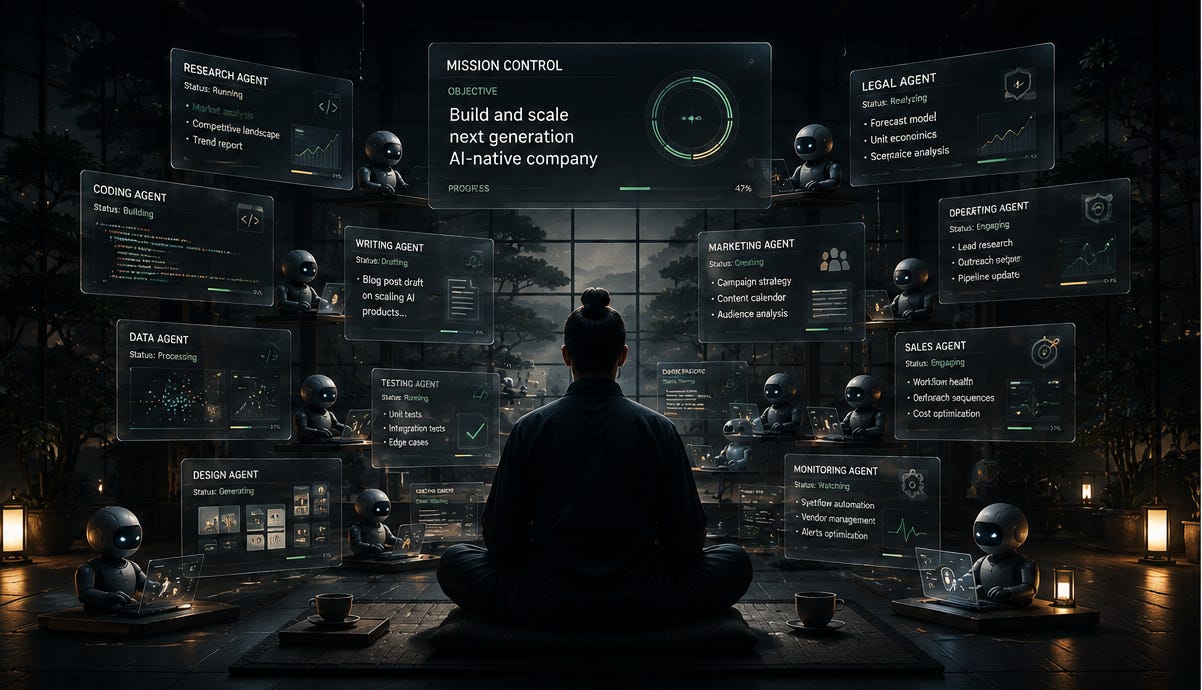
More machines, more problems. A company remade as a single intelligence, or a fleet of agents with one person directing them, multiplies what one operator can reach.
The better the agents get, the more a single person can do, the more important they become, and the more they are worth.
The Measure of All Things
The atomic unit of capability is indivisible for a reason. Trace the value down, through a harness, a company, or the agent economy itself, and you arrive at either a single person or a collection of them. The same goes for the chain of accountability.
The AI-enhanced operator is the atomic unit of value creation in AI: the smallest indivisible piece of specialized intelligence.
The firm was once the only thing that could be a whole, because no single person could do it all. Now every improvement in the machines increases what one operator can produce: the better the agents get, the better the human becomes.
All the money spent on compute, models, and agents ultimately only converts into value by virtue of the people skilled enough to use them. The agent economy held up as the next great explosion in productivity cannot reach its potential without them.